Every B2B SaaS founder we talk to eventually asks the same question: "When should we start running ads?"
Our answer is almost always the same: not yet. And usually, not for the first 100 users.
Paid acquisition is the worst place to start a B2B SaaS. It's expensive per lead, slow to optimize with small data volumes, and — most importantly — it teaches you almost nothing about why people actually buy your product. The founders who hit 100 paying users fastest in 2026 aren't the ones with the biggest ad budgets. They're the ones who treat the first 100 customers as a research project, not a growth channel.
Here's the playbook we walk our MVP clients through — the same one we use to get early traction for products we help build and launch.
Why Paid Ads Don't Work This Early
Let's get this out of the way. You might hit 100 users through paid ads. A lot of people do. But you'll spend ₹3–6 lakhs doing it, and you'll learn almost nothing except which ad creative got clicks.
B2B buyers don't impulse-buy software from a Meta ad. They buy after:
- Seeing your name 4–6 times across different surfaces
- Reading something that convinced them you understand their problem
- Getting a referral or social proof from someone they trust
- Having a real conversation with you or your team
Ads can help with the first one at scale, but they can't do the rest. And until you have the rest figured out, ad spend is just a faster way to lose money.
The First 100 Users: A 3-Phase Framework
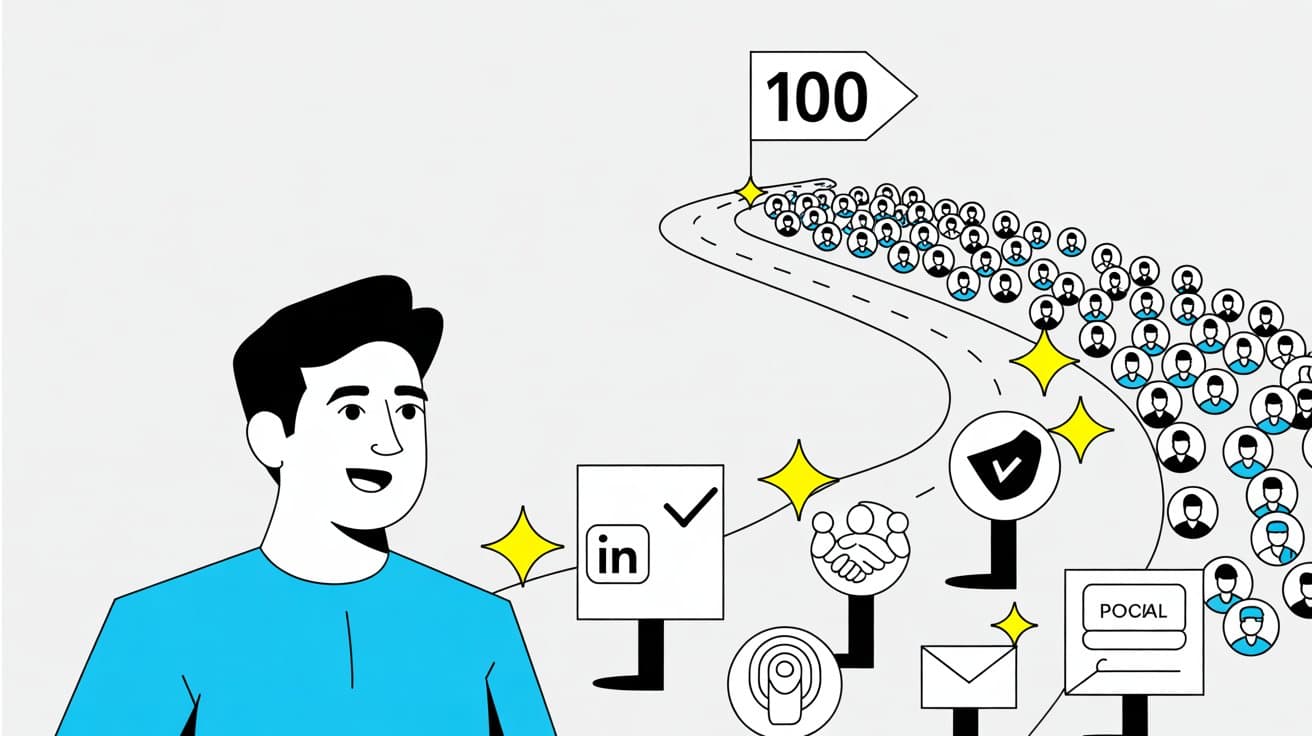
We tell founders to think of the first 100 users in three distinct phases, each with a different goal.
Users 1–20: Research Mode
These aren't customers. They're co-designers. Your goal isn't revenue — it's understanding whether the problem you're solving is actually painful enough that someone will pay for a half-finished solution.
Get these users one at a time. Manually. From your own network, your co-founder's network, and warm intros. Do 30-minute onboarding calls with every single one of them. Ask stupid questions. Watch them use the product. Write down every moment of confusion.
If you can't get 20 people from your combined network to even try your product, that's a signal — not about distribution, but about positioning or ICP. Going back to scoping is cheaper than buying ads to mask the problem.
Users 21–50: Validation Mode
Now you're testing whether people outside your immediate circle will buy. This is where founder-led outbound and content start doing real work. The goal: can you consistently acquire users from cold-ish sources?
The metrics that matter here aren't MRR. They're:
- What channel brought them in?
- How long from first touch to signup?
- Do they activate (use the core feature in week 1)?
- Do they come back in week 2?
Users 51–100: Loop Mode
By now, you should see one or two channels producing users more reliably than others. This phase is about turning those channels into repeatable motions — not adding new ones. Double down on what's working. The founders who try to run 8 channels in parallel at this stage burn out and get nowhere.
The Three Channels That Actually Work
Across dozens of B2B MVPs we've helped launch, the same three channels keep producing the first 100 users. The mix varies by ICP, but the channels don't.
Channel 1: Founder-Led Outbound (Still the Highest ROI)
This is the least sexy and most effective channel for early B2B. Not SDR-style cold email blasts. Real, researched, one-at-a-time outreach from the founder.
What works in 2026:
- Trigger-based outreach. Don't email random ICPs. Email someone who just raised a round, posted about the problem you solve, changed jobs, or launched something related. The trigger is the opener.
- Short, specific messages. No "hope this finds you well." Lead with why you're reaching out to them specifically, and what you'd like to show them in 15 minutes.
- LinkedIn DM + email combo. Cold email alone converts at 1–3%. Warm LinkedIn connection followed by a DM and then an email referencing the DM converts at 5–10% for most B2B categories.
The trap: founders stop doing this after 20–30 messages because it's tedious. The ones who push through 200–300 personalized touches hit 30–50 users from this channel alone.
Channel 2: Content That Ranks for Buying Intent
You don't need a blog with 200 posts. You need 5–10 posts that rank for the specific queries your buyers type when they're ready to evaluate a tool like yours.
Think less "10 productivity tips for founders" and more:
- "[Competitor] vs [Competitor] — Which One Should You Actually Use?"
- "How Much Does [Category of Tool] Cost in 2026?"
- "Best [Tool Category] for [Specific ICP Use Case]"
- "How to [Specific Job to Be Done] Without [Common Workaround]"
These posts don't drive massive traffic. They drive buyer traffic. A post that gets 400 visits a month from people actively comparing solutions in your category is worth more than a viral post with 40,000 visits from people who'll never buy.
This is also where AI-assisted content production has genuinely shifted the economics. You can research, draft, and polish 5–10 high-quality SEO-targeted posts in 3–4 weeks — work that used to take a content team a quarter.
Channel 3: Community Presence (Not Community Building)
There's a critical distinction here. Building a community is a 2-year investment that most MVP-stage founders can't afford. Being present in existing communities where your ICP already hangs out is a 2-week action item that consistently produces users.
Concretely:
- Identify 3–5 communities (Slack groups, subreddits, Discord servers, niche forums, industry WhatsApp groups) where your ICP is active.
- Don't pitch. Help. Answer questions in your domain. Share useful frameworks. Get known as the person who knows about X.
- When someone asks a question your product solves, mention it — but mention it honestly, including limitations.
Paired with this: a personal presence on LinkedIn or Twitter if your ICP lives there. For technical B2B founders in 2026, a consistent LinkedIn presence (3–4 posts a week about the problem space, your learnings, your build process) outperforms cold email as a top-of-funnel channel. We've watched founders get 15–25 inbound signups a month from LinkedIn alone once they hit consistency.
What Doesn't Work (But Founders Keep Trying)
A few common instincts that consistently fail at this stage:
- Product Hunt launches as a primary strategy. Great for signups, bad for paying B2B users. Most PH traffic is tire-kickers. Use it as a supporting moment, not a primary channel.
- Influencer sponsorships. Almost never works for B2B SaaS below 100 users. You don't have enough brand to convert their audience yet.
- Appearing on podcasts. Fun, but low conversion. Worth doing for credibility and backlinks, not for user acquisition.
- Writing on Medium/Hashnode hoping to get discovered. Own your distribution. Post on your site, share on LinkedIn/Twitter, distribute to newsletters you have access to.
- Affiliate programs before you have product-market fit. Affiliates amplify what works. If nothing's working, they amplify nothing.
The Metric That Actually Matters Before 100 Users
It's not MRR. It's not signups. It's not activation rate.
It's conversations per week. How many potential or actual users are you talking to directly — on calls, DMs, in-person — every week?
If the answer is 10+, you'll find your first 100 users. If it's 0–2, you won't, regardless of what your landing page looks like or how clever your product is. Founder-led distribution in the 0-to-100 phase is almost entirely a function of how many humans you're willing to talk to.
When You Should Start Thinking About Paid
After you've hit 100 paying users organically, you'll know three things that make paid ads actually work:
- Which segment converts best. Not your assumed ICP — your actual one, based on who paid.
- Which message resonates. Pulled directly from the language your best customers used on calls.
- Your rough LTV. Even a directional number lets you calculate a CAC ceiling.
Without these three inputs, paid ads are a guessing game. With them, paid becomes a legitimate growth lever — not a hope-and-pray strategy.
What We Recommend
If you're about to launch a B2B SaaS MVP, resist the instinct to "turn on" paid acquisition at launch. It will cost you more than money — it'll cost you the clarity that only comes from manually acquiring your first users one conversation at a time.
Pick two of the three channels above. Run them for 90 days. Talk to every user personally. By the time you hit 100, you'll have a product positioned correctly, a clear picture of your ICP, and a foundation that paid acquisition can actually amplify.
We help founders scope, build, and launch AI-integrated MVPs in 8–12 weeks — and map out the distribution plan for the first 100 users alongside the build, so shipping and traction happen in parallel. If you're pre-launch or just launched and stuck on distribution, talk to us. We'll tell you honestly whether your positioning, product, or channel mix is the actual blocker.